

Word-Of-the-Week #2001: Aging
September 25, 2025 by Susan Clarke · Comments Off on Word-Of-the-Week #2001: Aging
Aging – the process of growing old or maturing.
Were you born before 1965? Are you prepared for the aging process?
This week’s WOW comes from my sweet husband, Chris, who shared this article from by Avery White at Vegoutmag.com, “Boomers who remain witty and sharp past 70 usually live by these 9 rules. A sharp mind past 70 isn’t guaranteed—but these 9 rules make all the difference. I am breaking it into 3 parts do the length.
There’s a particular quality some older people have—a spark that makes you forget you’re talking to someone who remembers when television was new. They drop perfectly timed jokes, recall obscure facts with startling clarity, and somehow manage to stay current without trying too hard. These aren’t just the genetically blessed. They’re people who’ve figured out that staying mentally sharp isn’t about sudoku puzzles and crosswords alone.
The difference between those who remain vibrant conversationalists at 75 and those who retreat into repetitive stories isn’t luck. It’s a collection of habits, attitudes, and deliberate choices that keep their minds flexible while their joints might not be. These rules aren’t complicated or expensive—they’re accessible to anyone willing to rethink what aging means for the brain.
- They treat curiosity like oxygen
The sharpest septuagenarians approach new information like they’re still 25 and figuring out the world. They ask follow-up questions about your job, genuinely want to understand cryptocurrency, and aren’t afraid to admit when something confuses them. This isn’t politeness—it’s intellectual survival.

- They collect experiences, not just memories
There’s a difference between having stories and having the same story. Sharp older adults keep adding chapters to their lives instead of just rereading the old ones. They try the new restaurant, take the unfamiliar route, say yes to invitations that younger them might have declined.
This isn’t about bungee jumping at 80. It’s about maintaining cognitive flexibility—the ability to adapt thinking to new situations. Every new experience forces the brain to create fresh connections. The mentally vibrant understand that routine might be comfortable, but variation is what keeps neurons firing. They know that the phrase “I’ve never tried that before” should never fully leave your vocabulary.
- They embrace technology without surrendering to it
The wittiest older adults have smartphones and know how to use them, but they’re not enslaved by them. They’ve learned enough technology to stay connected and informed without letting it overwhelm their identity or dominate their time. They text their grandkids, share memes that actually land, and can navigate streaming services without assistance.
But here’s the key: they use technology as a tool, not a crutch. They understand that digital engagement opens doors to information and connection, but they don’t mistake online interaction for real relationships. They’ve found the sweet spot between being a Luddite and being lost in the digital world. Their social media posts are coherent, but they also don’t live for likes.
This week is all about the positives in aging! How curious are you? Are you experiencing new and different adventures you’ve never tried before? Do you embrace technology and yet still maintain real relationships?
I LOVE feedback! Join my Facebook community on my FUN-damentals Fan Page.
Word-Of-the-Week #2000: Endorphins
September 18, 2025 by Susan Clarke · Comments Off on Word-Of-the-Week #2000: Endorphins
Endorphins – hormones in the brain that reduce the sensation of pain and affect emotions.
Have you ever experienced the “runners high?” Would you like to have greater feelings of happiness and well-being? Can you imagine having a natural pain killer, like a narcotic, with no harmful side effects anytime day or night?
This week’s WOW is a great follow up to last week’s Smile. When you smile it increases your endorphins and that makes you feel even better. And if you want more bang, just add laughter as much as possible! 🙂
This is my favorite on line source for definitions, TheFreeDictionary.com which read, “Endorphins are long chains of amino acids, or polypeptides, that are able to bind to the neuroreceptors in the brain and are capable of relieving pain in a manner similar to that of morphine.
There are three major types of endorphins: beta-endorphins are found almost entirely in the pituitary gland, while enkephalins and dynorphins are both distributed throughout the nervous system. Scientists had suspected that analgesic opiates, such as morphine and heroin, worked effectively against pain because the body had receptors that were activated by such drugs. They reasoned that these receptors probably existed because the body itself had natural painkilling compounds that also bonded to those receptors.

When scientists in the 1970s isolated a biochemical from a pituitary gland hormone that showed analgesic properties, Choh Li, a chemist from Berkeley, California, named it endorphin, meaning “the morphine within.” Besides behaving as a pain reducer, endorphins are also thought to be connected to euphoric feelings, appetite modulation, and the release of sex hormones. Prolonged, continuous exercise contributes to an increased production of endorphins and, in some people, the subsequent “runner’s high.”
And lastly, this on smiling from the obituary of John Shields, who was the CEO of Trader Joe’s and was responsible for making it a national powerhouse chain, “When he interviewed someone for retail, he wouldn’t hire them if they didn’t smile within 30 seconds.”
This week is all about endorphins! How often do you smile in the course of the day? How about your staff or co-workers? Have you ever put much thought on the importance of hiring people (or picking friends) who smile?
I LOVE feedback! Join my Facebook community on my FUN-damentals Fan Page.
Word-Of-the-Week #1099: Smile
September 11, 2025 by Susan Clarke · Comments Off on Word-Of-the-Week #1099: Smile
Smile – a change of facial expression involving a brightening of the eyes and an upward curving of the corners of the mouth.
When was the last time someone smiled at you? Does it happen daily? Weekly? How did it make you feel? How often do you smile?
This is #4 of my 7 Simple Steps of Service. Did you know that there are 80 muscles in the face capable of making 7000 expressions? And it only takes one to show enjoyment, while most of the other emotions require the actions of three to five muscles.
A smile is the easiest expression to recognize and can be seen further away (300 feet) and with a briefer exposure than other emotional expression. Did you also know that it’s almost impossible not to reciprocate a smile? People do so even if the smile they reciprocate is one shown in a photograph!
And for those of you who spend any time on the phone, put a smile on your face and the tone of your voice will instantly change.
And this quote comes from long time friend and consultant Bill Marvin, the Restaurant Doctor, “If you want a crew that smiles (and you definitely want a crew that smiles), you have to hire smiling people. The rest you can train … but I have never found a way to teach people how to smile. And treat your team the way you want them to treat your guests. The better they feel about themselves, the more they will smile. The more they smile, the better your guests will feel. The better your guests feel, the more they will patronize you … and the more that happens, the better YOU will feel!”
This week’s focus is on your smile. Do you feel that instant connection and sense of recognition when you are the recipient of the smile? Did you know that when you smile it increases your endorphins and that makes you feel even better? More on that next week!
I LOVE feedback! Join my Facebook community on my FUN-damentals Fan Page.
Word-Of-the-Week #1098: Achievers
September 4, 2025 by Susan Clarke · Comments Off on Word-Of-the-Week #1098: Achievers
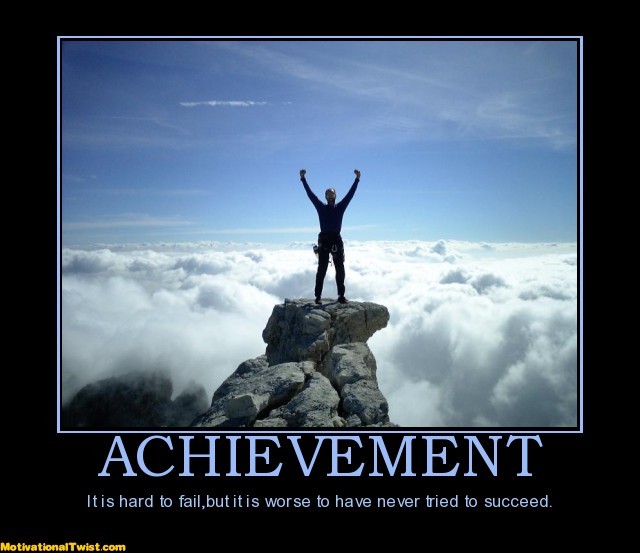
Achievers – one’s successful in accomplishing their goals.
Did you know that only 8 percent of people actually achieve their goals? Do you write down your goals? How specific and challenging are they?
This week features Marcel Schwantes, Inc. Union Tribune article, “Getting to the Goal: Here’s how achievers do it.” It felt like a good time to revisit this past WOW. If you made a New Year’s resolution, how are you doing so far?
“According to the University of Scranton, a whopping 92 percent of people who set New Year’s goals never actually achieve them. You can count me in that group. Failing to meet goals is pretty frustrating and can set you back.
That leaves 8 percent of us in a very elite category of goal-achievers. What do they do differently that 92 percent of us are missing out on? Most of the time, it comes down to simple habits to keep us accountable.
- They begin with the end in mind.
When setting goals, you have to know where you’re headed. When writing down your goals, make sure that you understand the path to your final destination. After all, a goal without a clear roadmap is just a pipe dream. Once you have your goal on paper, write out what you’ll need to get there. These are your subgoals and the resources that you will need to support you along the way.
- They build a support system around them.
High performers and productive people don’t do it alone. They understand that they can achieve more and do it quicker with the help of a mentor, coach, or adviser (or advisory team). If you wanted to get better at tennis, you would probably hire an instructor who would help you improve your serve or backhand volley. Setting and meeting larger goals is no different. Look for allies and build a network of experts who care about your success and keep you heading toward your goals. Meet with them regularly, seek their wisdom, ask for advice, and listen carefully.
- They set specific and challenging goals.
Research by Edwin Locke and Gary Latham found that when people followed these two principles (specific and challenging goals), it led to higher performance 90 percent of the time. For example, if your goal is to lose 30 pounds by the end of the year, it may be challenging, but it’s too vague and not specific enough. Try this instead: “During the month of July, I will lose five pounds by reducing sugar, breads, and soda. I will also walk briskly for 20 minutes daily.” When you have that much clarity around your goal, your chances of hitting the mark increase dramatically.”
And I was taught to use present tense. So, on July 1st I would say, “I briskly walk everyday for 20 minutes and I lost 5 pounds because I cut back on sugar, bread & soda.”
This week’s all about being an achiever. Do you have a clear roadmap for accomplishing your goal? Do you have a support system of mentors or advisers to help you? Is your goal challenging and have you made it clear and specific?
I LOVE feedback! Join my Facebook community on my FUN-damentals Fan Page.
Word-Of-the-Week #1097: Routine
August 28, 2025 by Susan Clarke · Comments Off on Word-Of-the-Week #1097: Routine
Routine– what you do every day that is habitual, unvarying, and unimaginative.
How much of your day feels habitual, unvarying, and unimaginative? Have you ever asked yourself, “Is my routine serving me or sabotaging me?”
This week features another great WOW from Sam Horn.
ANECDOTE
Years ago, a woman in my Someday salon told me, “The juice has gone out of my life, and I’m not sure why.”
When she shared what her days consisted of, she realized every day looked the same.
Up at 6:30, breakfast, an hour commute, full day of meetings, lunch at her desk, an hour commute home.
Followed by eating dinner while watching TV or scrolling social media, and bed at 11 pm.
Then the next day, rinse and repeat. No wonder her life has become a bit of a blah.
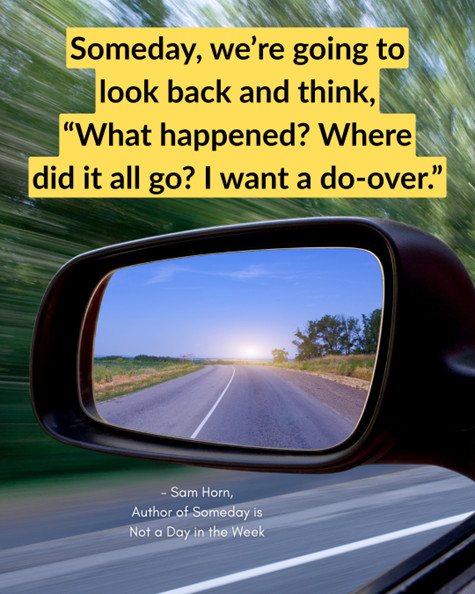
Days feeling “same old-same old” is a prescription for regrets.
The good news is, we can have a “do-over” on any given day.
The key is to look at our daily routines and ask, “Is this serving or sabotaging me?”
Some routines serve a good purpose. For example, walking our dog every morning
can be a GOOD routine. It is a mood LIFTER.
Some routines are mood DOWNERS. They may have started out
serving a good purpose, but they’ve become rote.
A good indication of routines that have become rote is if we do them on autopilot.
When we’re on autopilot, we’re only half there. And if we’re only half there, we’re missing half our life.
ACTION
- Take two minutes right now to think through your day. What do you do – day in, day out? What has become a rote routine?
- How can you change it? What can you do to put some juice back into your life? It doesn’t have to be a big thing; little things can have a big impact.
- TIP: Try seeing someone or doing something – as if for the first time. Really look at them, experience it, with fresh eyes and newfound appreciation. The second you do, life will cease to be… routine.
This week’s focus is about your routine. Do you feel like the juice has gone out of your life? What routines serve a good purpose and are a “mood lifter?” How would it feel to have everyday filled with interesting and enjoyable experiences?
I LOVE feedback! Join my Facebook community on my FUN-damentals Fan Page.