

Word-Of-the-Week #1097: Routine
August 28, 2025 by Susan Clarke · Comments Off on Word-Of-the-Week #1097: Routine
Routine– what you do every day that is habitual, unvarying, and unimaginative.
How much of your day feels habitual, unvarying, and unimaginative? Have you ever asked yourself, “Is my routine serving me or sabotaging me?”
This week features another great WOW from Sam Horn.
ANECDOTE
Years ago, a woman in my Someday salon told me, “The juice has gone out of my life, and I’m not sure why.”
When she shared what her days consisted of, she realized every day looked the same.
Up at 6:30, breakfast, an hour commute, full day of meetings, lunch at her desk, an hour commute home.
Followed by eating dinner while watching TV or scrolling social media, and bed at 11 pm.
Then the next day, rinse and repeat. No wonder her life has become a bit of a blah.
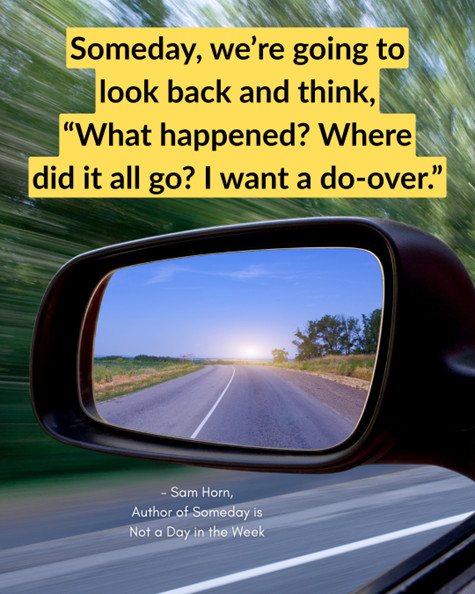
Days feeling “same old-same old” is a prescription for regrets.
The good news is, we can have a “do-over” on any given day.
The key is to look at our daily routines and ask, “Is this serving or sabotaging me?”
Some routines serve a good purpose. For example, walking our dog every morning
can be a GOOD routine. It is a mood LIFTER.
Some routines are mood DOWNERS. They may have started out
serving a good purpose, but they’ve become rote.
A good indication of routines that have become rote is if we do them on autopilot.
When we’re on autopilot, we’re only half there. And if we’re only half there, we’re missing half our life.
ACTION
- Take two minutes right now to think through your day. What do you do – day in, day out? What has become a rote routine?
- How can you change it? What can you do to put some juice back into your life? It doesn’t have to be a big thing; little things can have a big impact.
- TIP: Try seeing someone or doing something – as if for the first time. Really look at them, experience it, with fresh eyes and newfound appreciation. The second you do, life will cease to be… routine.
This week’s focus is about your routine. Do you feel like the juice has gone out of your life? What routines serve a good purpose and are a “mood lifter?” How would it feel to have everyday filled with interesting and enjoyable experiences?
I LOVE feedback! Join my Facebook community on my FUN-damentals Fan Page.
Word-Of-the-Week #1096: Enjoyment
August 21, 2025 by Susan Clarke · Comments Off on Word-Of-the-Week #1096: Enjoyment
Enjoyment– the pleasure felt when having a good time.
Are you waiting for the right time to have a “special occasion”? Do you believe that difficult tasks will somehow be easier in the future?
This week features the last half of “Why we procrastinate on joy, and how to stop,” by Richard Sima of The Washington Post.
We may fall into a ‘trap’ of wanting something to feel special, which causes us to delay enjoying it now, research says
To Recap:
- Waiting on joy
The new research suggests that people delay enjoyable experiences to maximize the benefits and avoid “spoiling the moment,” O’Brien said.
“‘Right now’ always feels insufficiently special compared to any better moment in the future,” he said.
This mindset may be shaped by what behavior psychologists call “occasion-matching,” a phenomenon in which people really care about when and where they enjoy things. We might wait to open an expensive bottle of wine for the perfect celebration even if it would taste just as good right now.
“Ironically, the thing that really builds dust is the really fine wine,” O’Brien said.
At the same time, we tend to believe we will have more time and energy in the future to do the things we like, which may be why people who live near landmarks and attractions often put off going to see them, as one 2010 study found. (Research also suggests that we tend to believe difficult tasks will somehow get easier to do in the future.)
However, while this general tendency is “important and interesting,” there may be more than one explanation for why different people procrastinate, said Akira Miyake, a professor of psychology and neuroscience at the University of Colorado at Boulder. “I think things are much more complex, and we need to start paying attention to idiosyncrasies or adopting more person-specific ways of looking at why this is happening,” he said.
For example, returning to a fun activity after a long break might require more effort to reacclimate, which is aversive.
Or seeking out specialness might relate to perfectionism, which is associated with procrastination tendencies in general, said Miyake, who was not involved in the study.
Plus, other goals we have may take more precedence, he said. “In everyday settings, you always pursue multiple goals,” Miyake said.

- How to stop putting off enjoyable experiences
We may not always be aware that we are procrastinating doing things that make us happy even when it comes at a cost, but there are strategies to help us, experts said.
Notice the trap: If we are more aware of the tendency to continue delaying positive things, we can catch ourselves and subvert it, O’Brien said.
Change the friction level: Borrowing from research on habit formation: If you want to do something positive, make it easier to do it. Come up with ways to remind yourself of what you want to do so you don’t forget it, Miyake said.
Schedule fun: Making a rule to do something enjoyable at a set time could make it easier to follow through than simply relying on willpower alone, Miyake said.
Change your mindset about what’s special: Trying to get over the trap of specialness may be key.
In one last set of experiments, O’Brien and his colleagues tested different strategies to get people to return to their long-delayed enjoyable activities sooner.
A strategy that surprisingly did not work was having participants reframe how much time had elapsed as not being that long in the grand scheme of things; they were still not more likely to jump back in compared with the control group, which received no such instruction.
Instead, what worked was reframing what could count as a special occasion.
“Think about how any moment can be made to feel extra special from the right perspective,” O’Brien said. “You can make any random Tuesday feel extra special if you really think about it.”
This week’s focus is on enjoyment Are you delaying positive things? How would it feel to schedule FUN?
I LOVE feedback! Join my Facebook community on my FUN-damentals Fan Page.
Word-Of-the-Week #1095: Procrastinate
August 14, 2025 by Susan Clarke · Comments Off on Word-Of-the-Week #1095: Procrastinate
Procrastinate – to postpone or delay needlessly.
How often do you delay or put things off? Could it be that you actually want to maximize pleasure?
This week features the first half of “Why we procrastinate on joy, and how to stop,” by Richard Sima of The Washington Post
We may fall into a ‘trap’ of wanting something to feel special, which causes us to delay enjoying it now, research says
“Usually, when we think about procrastination, we think about delaying the hard, boring or unpleasant things in life — paying bills, doing laundry or meeting work deadlines. The bulk of scientific research focuses on why we delay pain, not pleasure.
But we can also put off things we enjoy — catching up with a friend we haven’t seen in a while, visiting a nearby attraction or opening that expensive bottle of wine.
A recent study published in the journal PNAS Nexus explored this hidden side of procrastination. And it found a surprising pattern — the longer we put off doing something we enjoy, the more likely we are to continue putting it off.
This may be because of the “psychological drama” we build up around the experience, suggested Ed O’Brien, the study’s author and an associate professor of behavioral science at the University of Chicago Booth School of Business.
It’s as if we believe that our first time back to, say, a favorite restaurant or reconnecting with a friend “shouldn’t be wasted. It should be kind of momentous and important and really matter to me,” he said.
We procrastinate not because of the cost or difficulty of doing something, but because we want to maximize the pleasure and specialness when it arrives.
But by doing so, we risk waiting in vain for a moment that may never come.

The research suggests that it’s a cognitive “trap” we can fall into where “people are missing out on lots of immediate happiness and lots of immediate enjoyment,” O’Brien said.
- Waiting on joy
Ironically, the researchers had been putting off this project on procrastination — until the coronavirus pandemic provided an unexpected natural experiment.
With many enjoyable activities — going to restaurants, theaters and parties; travel; and visiting family — on pause, the researchers could see how long it took people to jump back in once they deemed it safe to do so.
O’Brien and a colleague asked 500 adults: How long was it since you got to enjoy each of these activities?
Then they asked: Did you return to that activity as soon as you thought it was safe, available and attractive? Or did you delay?
Surprisingly, the longer participants reported not being able to do something, the more likely they were to wait even more.
“Once restaurants were back open and they felt safe and comfortable … they actually waited even longer because they didn’t want their first time back to a restaurant to just be on a random Tuesday without a good crowd,” O’Brien said. “They were waiting for the perfect time to celebrate that coming back moment. So, ironically, they waited even longer.”
A long gap seems to precede an even longer gap.
The same pattern held for something more ordinary: reaching out to a friend.
In one experiment, the researchers asked 200 participants to think about a close friend they had communicated with recently (a short gap) or one they had communicated with some time back (a long gap).
Then, the participants were asked to choose what they wanted to do with their time in the laboratory: text that close friend or transcribe nonsense text — a purposefully mundane task.
In theory, texting a friend should have both been easier and more fun.
But the longer the gap, the more people hesitated and opted to do the boring task instead.
There appeared to be immediate negative consequences: After the experiment, participants who chose not to text the friend reported being less happy, probably because they did something boring instead.
Even when the researchers controlled for different confounding factors in another experiment, involving 1,000 participants — making sure that the friends were equally close and that there was no social anxiety or fear of social rejection — people persisted in procrastinating when there was a long gap, even when it would have been enjoyable.
Why do we procrastinate doing things we enjoy?
The new research suggests that people delay enjoyable experiences to maximize the benefits and avoid “spoiling the moment,” O’Brien said.
This week’s focus is on procrastination. Are you missing out on lots of immediate happiness and lots of immediate enjoyment because of it? Is it because you are afraid of not being able to make it perfect?
I LOVE feedback! Join my Facebook community on my FUN-damentals Fan Page.
Word-Of-the-Week #1094: Abilities
August 7, 2025 by Susan Clarke · Comments Off on Word-Of-the-Week #1094: Abilities
Abilities – possession of the qualities required to do something.
Do you realize what you focus on will expand? Like the saying, “What goes around, comes around.”
Once again, Steve Strauss, author of STEVE’S 3-MINUTE COACHING, sent a very thought-provoking piece!
Principle: Abilities
(Principles are basic truths that, when applied, cause success to come to you easier and quicker.)
Driving home from the gym this morning I was behind a service van for a not-for-profit organization. Their slogan/motto/theme was painted in big letters –
“Abilities Outweigh Disabilities.”
So simple. So true. But.
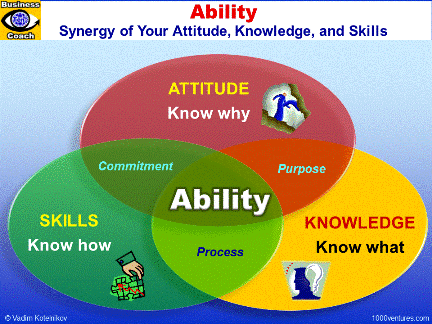
When we focus on the disabilities – those of our own or those we perceive in others – we see more of them. The effect is we are blocked /constrained/limited by our disabilities. The old saying is, “what you focus on expands.”
Your abilities? They are myriad, multifaceted, and meaningful. When abilities are focused upon there is no room for victim. No room for ‘I can’t.’ When abilities are ascendant possibilities grow. Truly, what you focus on expands.
Coaching Point: Do you know, acknowledge, and celebrate your abilities?
See all past issues and subscribe here Steve’s 3-Minute Coaching
Copyright © 2025 Steve Straus, All rights reserved.
This week’s is all about your abilities. What are you focusing on? Are you feeling blocked or are you expanding?
I LOVE feedback! Join my Facebook community on my FUN-damentals Fan Page.